Discover the vital role of MongoDB in modern full-stack web development. Learn why this NoSQL database is preferred over traditional SQL systems for scaling modern MERN stack applications.
Understanding the True Role of MongoDB in Full-Stack Web Development
When we talk about building a complete full-stack web application, managing data efficiently is one of the most critical challenges. Whether it is user profile information, product catalogs, order details, or real-time chat logs, you need a resilient database layer to store and retrieve information securely. In modern architectures, MongoDB has emerged as the most popular database choice to handle this requirement. If you want to become a successful software engineer, you must dive deep into understanding what the actual role of MongoDB is and why it stands out from traditional systems.
At Vivaa Technologies, we focus on training students with industry-relevant skills so they can architect highly performant and scalable web applications easily.
Where MongoDB Fits Into the Full-Stack Architecture
In a traditional web application setup, relational databases like MySQL or PostgreSQL were the default choices. These databases require a fixed schema where data is stored rigidly in tables, rows, and columns. However, modern web applications handle highly dynamic and unstructured data. This is exactly where MongoDB changes the game. MongoDB is a NoSQL, document-oriented database that stores data in flexible, JSON-like formats called BSON. This means that data is stored natively in a structure that closely mimics how JavaScript objects look, making backend integration incredibly seamless.
Key Aspects: The Practical Role of MongoDB in Web Applications
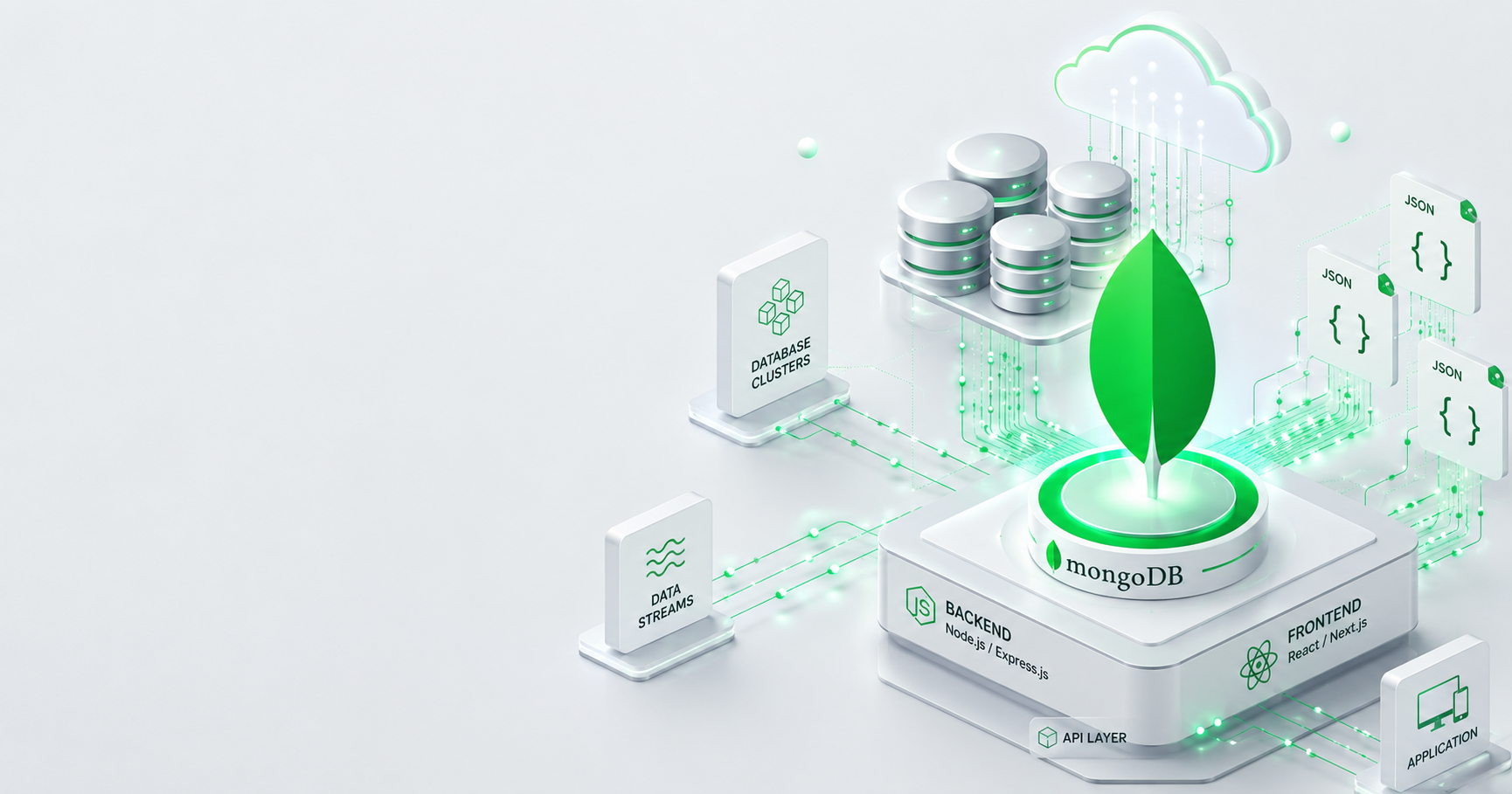
When working with modern stacks like the MERN stack (MongoDB, Express.js, React.js, Node.js), the data layer heavily relies on MongoDB. Let us break down its essential functions:
1. Handling Flexible Schemas and Dynamic Data
Requirements change fast during a project lifecycle. If you need to add a new property to a user profile, such as a secondary phone number, traditional SQL databases require running migrations or altering the entire table schema. MongoDB allows you to store documents with completely different structures inside the same collection, giving you immense flexibility to evolve your data architecture.
2. High Performance and Fast Read/Write Cycles
Because MongoDB stores data in nested document formats, related information is stored together rather than being scattered across multiple tables. This architecture eliminates the need for expensive table joins. When your Node.js backend queries the database, MongoDB retrieves the entire document instantly, leading to faster data response times and boosted application performance.
3. Native Horizontal Scalability through Sharding
As applications grow to support millions of concurrent users, a single server cannot handle the immense data load. MongoDB solves this by using built-in sharding. It automatically distributes data across a cluster of multiple machines. This horizontal scaling capability ensures that your full-stack system can handle traffic spikes without any unexpected system downtime.
4. Perfect Synchronization with the JavaScript Ecosystem
Since MongoDB stores data in a format that maps directly to JSON, developers do not need to deal with complex Object-Relational Mapping tools to convert data models between the backend server and the database. The React.js frontend, Node.js backend, and MongoDB database all communicate using the same object structure, accelerating the overall development speed.
Conclusion
To sum it up, MongoDB acts as the highly flexible and scalable memory of your modern web application. It removes the structural boundaries of data management, allowing your backend application to process heavy workloads at incredible speeds.
If you are eager to master NoSQL databases and build robust full-stack systems, our dedicated mentorship programs at Vivaa Technologies are designed to guide you through hands-on project building.